Pictures from Israel

Click to enlarge
+Israel-©-MEA-20180307-(FD)-History-of-Israel–Tabernacle-Model-Timna-Park
History of Israel –Tabernacle Model -Timna Park
Timna Park, located 25 kilometres North of Eilat, centres its focus on history, antiquities and a variety of activities (such as the coloured sands and the artificial lake) within the beautiful wilderness surrounds. Its acacia trees and other arid-land vegetation, its herds of wild ibex looking out at you from the cliff tops, and its evidence of human activity from antiquity to the present all make Timna Park a worthwhile place to visit. This horseshoe-shaped Valley covers some 15,000 acres and is surrounded by steep cliffs and Mount Timna which is 453 metres above sea level. The valley contains many minerals such as iron, manganese and more importantly, copper. Timna is the site of the world’s first copper mine and thousands of ancient mining shafts can be seen throughout the park as well as remains of smelting furnaces dating back to imperial Egypt. Historically, copper was the first metal used to create work and household tools, weapons, costly ornaments and cultic objects.
Visitors to Timna Park can watch a multimedia presentation titled ‘The Mines of Time’ which bring many mythological and ancient stories of copper gods and Pharaoh Ramses to life, including the history of copper-mining from ancient Egyptian times to the present.
A full-scale replica of the biblical Tabernacle (Insert) stands in the very wilderness where Moses and the children of Israel wandered for forty years. When reading the Biblical account of the dimensions of the Tabernacle as outlined in Exodus Chapter 26, one tends to think it to be much bigger that what it really is. However, a more realistic size of the Tabernacle is shown in the photograph above—seeing is believing. The following Bible verses show how much God wanted to be in fellowship with His chosen people. “Then the cloud covered the tent of meeting, and the glory of Adonai filled the tabernacle. Moshe was unable to enter the tent of meeting, because the cloud remained on it, and the glory of Adonai filled the tabernacle.” (Exodus 40:34-35 CJB).
Copyright exists in all the material on this website and is owned by Messianic Education Australia Ltd. unless otherwise explicitly stated. This copyright extends to the images, logos, layout and presentation styles as well as the text material.
Pictures from Israel

Click to enlarge
Israel-©-MEA-20180228-(C285)-Historical-Icons-of-Israel–Montefiore-Windmill
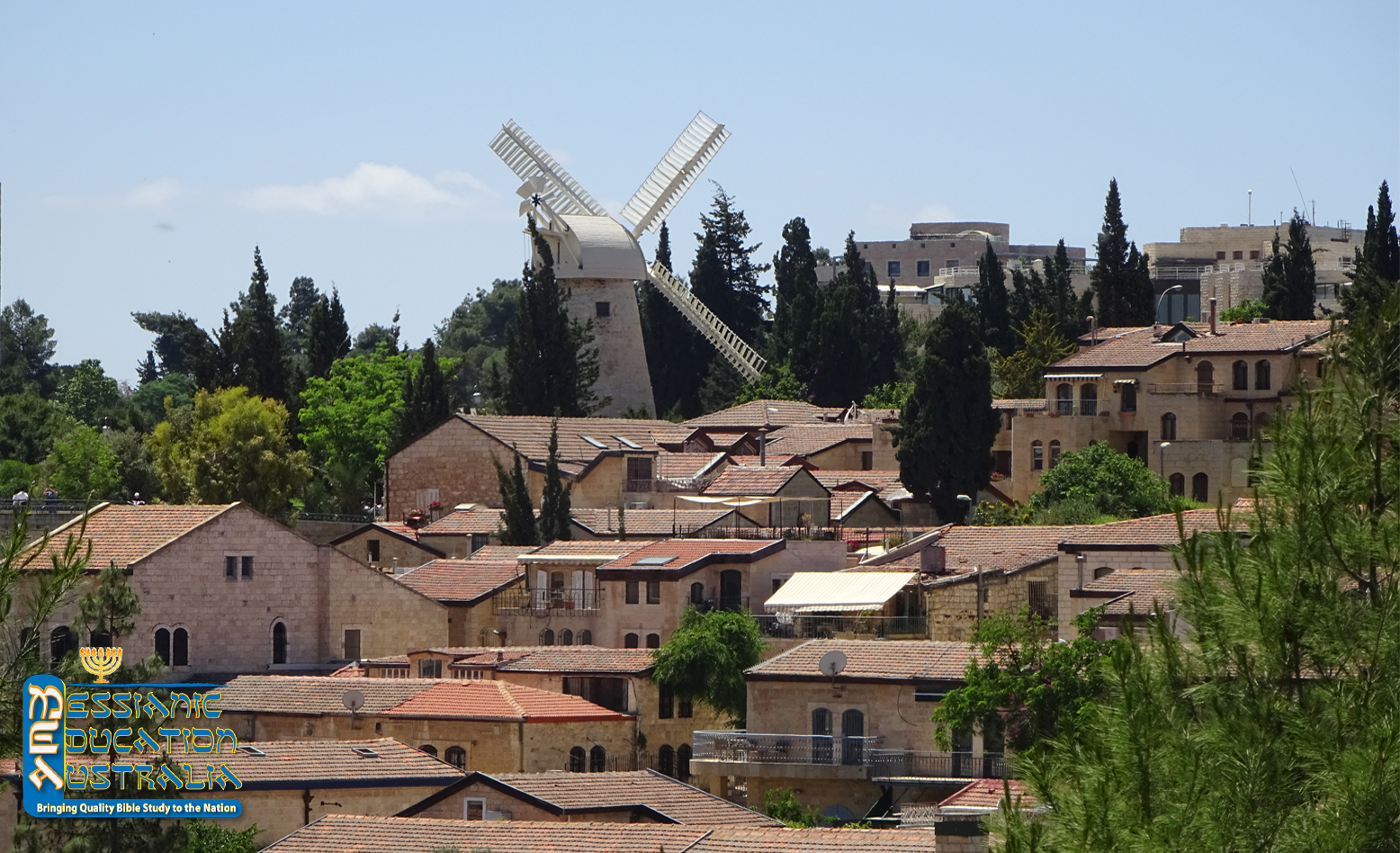
Historical Icons of Israel –Montefiore Windmill
The Montefiore Windmill, built by English Jewish philanthropist Moses Montefiore, was one of the first structures to be erected outside the borders of Old City in Jerusalem during the middle of the 19th Century. This four-bladed windmill of European design was finished in 1857. This fully-functional agricultural wheat-grinding windmill was to be a beacon for Jerusalem’s future, an inspiration to the Jews of Palestine to become more self-supporting. Unfortunately, despite the good intentions, the wind in the area was unreliably and often not strong enough to provide efficient and constant milling of the hardier crops of the area. So, after 18 years it was made obsolete, unable to compete with other methods of flour production. It would be more than a century later before it would be resurrected. Even so, the windmill did manage to inspire people to relocate to the area establishing homes, synagogues, businesses and trade.
The Montefiore Windmill sat empty for decades until the Israeli army used it during the War of Independence as a watch post. Then the British forces blew the top off of the windmill in an action known as ‘Operation Don Quixote’. Following this, the damaged building sat empty until 2012 when, as part of the celebrations of the 60th anniversary of the establishment of Israel, the windmill was completely restored.
A book published in 1933 referred to the windmill as the Jaffa Gate Mill, and mentioned how local millers were opposed to the windmill, even to point of cursing it because it was seen to be the work of Satan. Also, some Arabs developed a taste for the lubricating oil used on the bearings, but soon stopped licking the oil for fear the mill would burn down from the resulting friction. This unsavoury habit ceased not long after a leg of pork was placed in the oil barrel.
Today the Montefiore Windmill, whose blades spin five days a week, stands as a monument to the creation of modern Israel and offers visitors a fine historical museum highlighting the life of Moses Montefiore.
Copyright exists in all the material on this website and is owned by Messianic Education Australia Ltd. unless otherwise explicitly stated. This copyright extends to the images, logos, layout and presentation styles as well as the text material.
Weekly Questions

Copyright exists in all the material on this website and is owned by Messianic Education Australia Ltd. unless otherwise explicitly stated. This copyright extends to the images, logos, layout and presentation styles as well as the text material.
Pictures from Israel

Click to enlarge
Israel-©-MEA-20180221-(C30)-Historical-Icons-of-Israel–The-Kotel
Historical-Icons-of-Israel–The-Kotel
The Kotel or the Western Wall, is the most significant prayer site in the world for the Jewish people. It is the last remnant of their Temple which was destroyed by the Romans in 70 AD. Many Jewish people from around the world gather here to pray and sometimes leave written prayer notes pushed between the mortar and the great ancient stones of the limestone wall. According to Jewish history and tradition, this Temple mount was originally known as Mount Moriah, and the place where many pivotal events in Jewish history occurred.
Traditionally, it is where the ‘Foundation Stone’ was set up for the creation of the world. Also, it is where Adam, the first human, was brought to life, and “the place which God chose” for Abraham to sacrificed his son Isaac—the peak of Mount Moriah. Also from the Bible, it is believed that there is a link between Mount Moriah and Jacob’s amazing dream of angels ascending and descending a ladder joining heaven and earth. There is another suggestion that the Holy of Holies, the holiest place within the First and Second Temples built around this same ‘Foundation Stone’.
In the year 37 BCE, Herod was appointed king in Jerusalem and soon began renovating the Second Temple which was almost completed by the time he died in 4 BCE. It was quite magnificent. In order to accommodate the total area required, Herod widened the land and built four support walls around it. However, the Western Wall was the only one that survived the Jerusalem’s. Sometime later in history, it become the central icon of Jewish identity and prayer.
After the 1948 Arab-Israeli War, the Eastern portion of Jerusalem was occupied by Jordan who expelled all Jews from the ‘Old City’ including the Jewish quarter which effectively barred them from praying at the Western Wall. However, on June 10, 1967, at the conclusion of the famous Six-Day War, All of Israel and Jewish people around the world rejoiced when the Western Wall was once again back in their hands.
Copyright exists in all the material on this website and is owned by Messianic Education Australia Ltd. unless otherwise explicitly stated. This copyright extends to the images, logos, layout and presentation styles as well as the text material.
Weekly Questions

Copyright exists in all the material on this website and is owned by Messianic Education Australia Ltd. unless otherwise explicitly stated. This copyright extends to the images, logos, layout and presentation styles as well as the text material.