Pictures from Israel

Click to enlarge
+Israel © MEA-20180404 (C592) History of Israel -IDF Tanks
History of Israel -IDF Tanks
Remnants of past military battles, abandoned tanks of all shapes and sizes are scattered across the landscapes of many different countries throughout the world, and Israel is no exception. Here we see tourists flocking around this outdated Sherman, an example of an Egyptian tank captured by the Israeli Defence Force (IDF) during the 1967 Six-Day War, and now on display at the Latrun Military Museum in Jerusalem.
Israel has had a long history of tank warfare, where they began using British and then American tanks. But even by the early 1960s, they knew they would have to develop and build their own unique style of tank. The Yom Kippur War in 1973 triggered a chain of military decisions, from which IDF Major General Israel Tal initiated a program for Israel to build its own ‘mystery’ tank, called the Merkava -meaning chariot, which entered service in 1979. It was a modest beginning, but this tank was more suitable to meet Israel’s specific needs, with extra protection flanking the outside making it more resistant to damage, and a rear hatch fitted for emergency evacuation by the tank crews.
Over the past three decades, and using their own engineering and technological skills, the IDF have continued to produce even more advanced Merkava tanks, which are commended for their innovative design, mobility and weaponry functions. The Merkava-2 model was the most heavily armed tank in the world. The structural design of the Merkava chassis was also adapted to be used in the manufacture an armoured ambulance (called the ‘Tankbulance’), and the Infantry Fighting Vehicle (called the Namer), amongst other military uses. The latest Merkava tanks are even more sophisticated and very necessary in defending the borders of the sovereign State of Israel and its people.
Copyright exists in all the material on this website and is owned by Messianic Education Australia Ltd. unless otherwise explicitly stated. This copyright extends to the images, logos, layout and presentation styles as well as the text material.
Pictures from Israel

Click to enlarge
+Israel © MEA-20180328 (FD) History of Israel -Eilat
History of Israel -Eilat
Eilat is Israel’s southernmost city, the ‘window on the Red Sea’ on the northern tip of the Red Sea in the Gulf of Aqaba, and surrounded by seven kilometres of Red-Sea coastline bordering Egypt, Jordan and desert landscapes—a popular domestic and international tourist destination. It has a busy port and a popular holiday resort with all the regular tourist attractions including: warm beaches, a coral reef with an aquarium, lots of day and night entertainment, and even desert-based activities. In the 1970s, charter flights to Israel brought foreign tourists to Eilat which greatly increased the popularity of the town.
Originally Eilat was a strategic military outpost, and as a port town, exported mainly potash and copper while also importing a wide variety of goods from Asia and Africa, including oil and vehicles. The ancient Hebrew name for Eilat was ‘Elath’, mentioned in the Book of Exodus from the Bible (meaning ‘Pistacia tree’). Eilat is one of the many places which the people of Israel passed through on their journey to the ‘Promised Land’. When King David conquered Edom, which bordered with Moab, he took over Eilat. Scholars suggest that His father, King Solomon also re-captured this commercial port city and copper based industrial centre from the Egyptians; then went on to develop the neighbouring town of Ezion-Geber cited in I Kings 9:26. And in 2 Kings 14:21-22, Israel’s young king Uzziah rebuilt Elath (Eilat). However, during this turbulent time, 2 Kings 16:6 records the king of Edom regained control of Eilat for the Edomite nation.
And, in more recent times, after Israel defeated the surrounding Arab nations in the 1948 Six-Day-War, Eilat became Israel’s crucial sea port for communications, commerce and trade when Egypt denied Israeli-registered ships passage through the Suez Canal, including ships carrying cargo to or from Israel. Regardless of Israel’s enemies, it remains a strong and vibrant nation, hailed as one of the best examples of democracy in the world.
Copyright exists in all the material on this website and is owned by Messianic Education Australia Ltd. unless otherwise explicitly stated. This copyright extends to the images, logos, layout and presentation styles as well as the text material.
Pictures from Israel

Click to enlarge
Israel © MEA-20180321 (FD) History of Israel -Jaffa Port Entrance
History of Israel -Jaffa Port Entrance
Today, the port of Jaffa, (Yafo in Hebrew) stands as a monument to a rich and ancient past that has survived many conquests by invaders and settlers alike. Surrounding the walled city with its high clock tower, are houses, shops, restaurants, parks and gardens, historical churches and a mosque. Jaffa, which is also called Japho or Joppa is considered one of the oldest, if not the oldest city, and lays claim to be the city which Yaphet (Jaffet) the son of Noah built after the Great Flood. Its name is derived from the Hebrew yafeh, meaning ‘beauty’.
Archaeological digs and ancient papyrus documents reveal that Jaffa existed as a seaport more than 4,000 years ago, suggesting it is the world’s oldest harbor in continual use. However, over time, Jaffa ceased to function as a major trading harbor because of the port’s narrow entrance, through which only small ships could enter. Today it’s a port for local fishing boats and small yachts. Israel’s main shipping now uses the ports of Ashdod and Haifa. Still, it’s easy to imagine the old days where traders arrived by sea – transferring their goods to camel caravans, destination Cairo, Jerusalem, Damascus, Yemen, Baghdad and beyond.
Historically, Jaffa has been occupied by the Egyptian, Hebrew, Babylonian, and Hittite Empires from 1700 to 1400 B.C.E., the Median, Chaldean and Lydian Empires during 600 B.C.E., the Persian Empire in 500 B.C.E., Alexander’s Hellenistic Empire beginning 323 B.C.E., the Roman and Parthian Empires from 117 B.C.E.; Persian, Sassanid and Byzantine Empires up to the 7th Century; followed by the Islamic Empire; Crusaders, Egyptians and others, up until the Turkish Empire in the 16th Century. The Ottomans were defeated by Napoleon who, in 1799 captured the city of Jaffa during the Napoleonic Wars. The British Empire occupied the area up until the establishment of the State of Israel in 1948.
The Bible records that the great cedar trees from Lebanon, required for King Solomon’s Temple were transported through Jaffa on their way to Jerusalem; the Apostle Peter performed many miracles in and around Jaffa, and; the story of Jonah records that Jonah fled in a ship from Yoppa (Jaffa) to avoid God’s instruction to go to Nineveh.
Copyright exists in all the material on this website and is owned by Messianic Education Australia Ltd. unless otherwise explicitly stated. This copyright extends to the images, logos, layout and presentation styles as well as the text material.
Pictures from Israel

Click to enlarge
+Israel © MEA-20180314 (C5–) History of Israel -Golan Heights
History of Israel -Golan Heights
The Golan Heights or otherwise called the Golan is an area of land, a rocky plateau located on the east and north sides of the Sea of Galilee (Kinneret) in the far North of Israel. Its borders are Israel, Lebanon, and Jordan. Israel maintains control of this 1,800 square kilometre area in a defensive role to stop enemy attack-rockets on its citizens which had been coming from the Golan. The Golan is 65km from North to South and averages about 20km from East to West. Despite its size, the Golan is very important, as it supplies Israel with over a third of its water.
Historically, many significant battles have been fought in this area—and the barbed-wire shown in the picture above is evidence of a more recent battle, Israel’s Six-Day War in 1967. In 1981 Israeli forces captured this part of the Golan from Syria and continue to monitor the area. After the 1948-1949 Arab-Israeli War, the Golan was partly demilitarised by the Israel-Syria Armistice Agreement, and over the years, has proved to be an area of continuing violence as the agreement is broken by both sides due to disagreement over the legal status of the demilitarised zone (DMZ), cultivation of land within it and competition over water resources.
According to the Book of Deuteronomy in the Bible, the Amorite king Og of Bashan was conquered by the Israelites coming out from Egypt around the 12th-13th Century B.C.E. Throughout the Old Testament period, the Golan was the focus of a power struggle between the Kings of Israel and the Aramaeans who were based near modern-day Damascus. In the 16th century, the Golan was conquered by the Ottoman Empire and was part of the Vilayet of Damascus until it was transferred to French control in 1918. When the mandate terminated in 1946, it became part of the newly independent Syrian Arab Republic.
The Golan is home to some of Israel’s most stunning and beautiful landscapes, far removed from the big cities and towns in the rest of the country, where. Its abundant water resource has created green landscapes and picturesque water-features, including Israel’s spectacular Saar Falls and The Banias Waterfall.
Copyright exists in all the material on this website and is owned by Messianic Education Australia Ltd. unless otherwise explicitly stated. This copyright extends to the images, logos, layout and presentation styles as well as the text material.
Pictures from Israel

Click to enlarge
+Israel-©-MEA-20180307-(FD)-History-of-Israel–Tabernacle-Model-Timna-Park
History of Israel –Tabernacle Model -Timna Park
Timna Park, located 25 kilometres North of Eilat, centres its focus on history, antiquities and a variety of activities (such as the coloured sands and the artificial lake) within the beautiful wilderness surrounds. Its acacia trees and other arid-land vegetation, its herds of wild ibex looking out at you from the cliff tops, and its evidence of human activity from antiquity to the present all make Timna Park a worthwhile place to visit. This horseshoe-shaped Valley covers some 15,000 acres and is surrounded by steep cliffs and Mount Timna which is 453 metres above sea level. The valley contains many minerals such as iron, manganese and more importantly, copper. Timna is the site of the world’s first copper mine and thousands of ancient mining shafts can be seen throughout the park as well as remains of smelting furnaces dating back to imperial Egypt. Historically, copper was the first metal used to create work and household tools, weapons, costly ornaments and cultic objects.
Visitors to Timna Park can watch a multimedia presentation titled ‘The Mines of Time’ which bring many mythological and ancient stories of copper gods and Pharaoh Ramses to life, including the history of copper-mining from ancient Egyptian times to the present.
A full-scale replica of the biblical Tabernacle (Insert) stands in the very wilderness where Moses and the children of Israel wandered for forty years. When reading the Biblical account of the dimensions of the Tabernacle as outlined in Exodus Chapter 26, one tends to think it to be much bigger that what it really is. However, a more realistic size of the Tabernacle is shown in the photograph above—seeing is believing. The following Bible verses show how much God wanted to be in fellowship with His chosen people. “Then the cloud covered the tent of meeting, and the glory of Adonai filled the tabernacle. Moshe was unable to enter the tent of meeting, because the cloud remained on it, and the glory of Adonai filled the tabernacle.” (Exodus 40:34-35 CJB).
Copyright exists in all the material on this website and is owned by Messianic Education Australia Ltd. unless otherwise explicitly stated. This copyright extends to the images, logos, layout and presentation styles as well as the text material.
Pictures from Israel

Click to enlarge
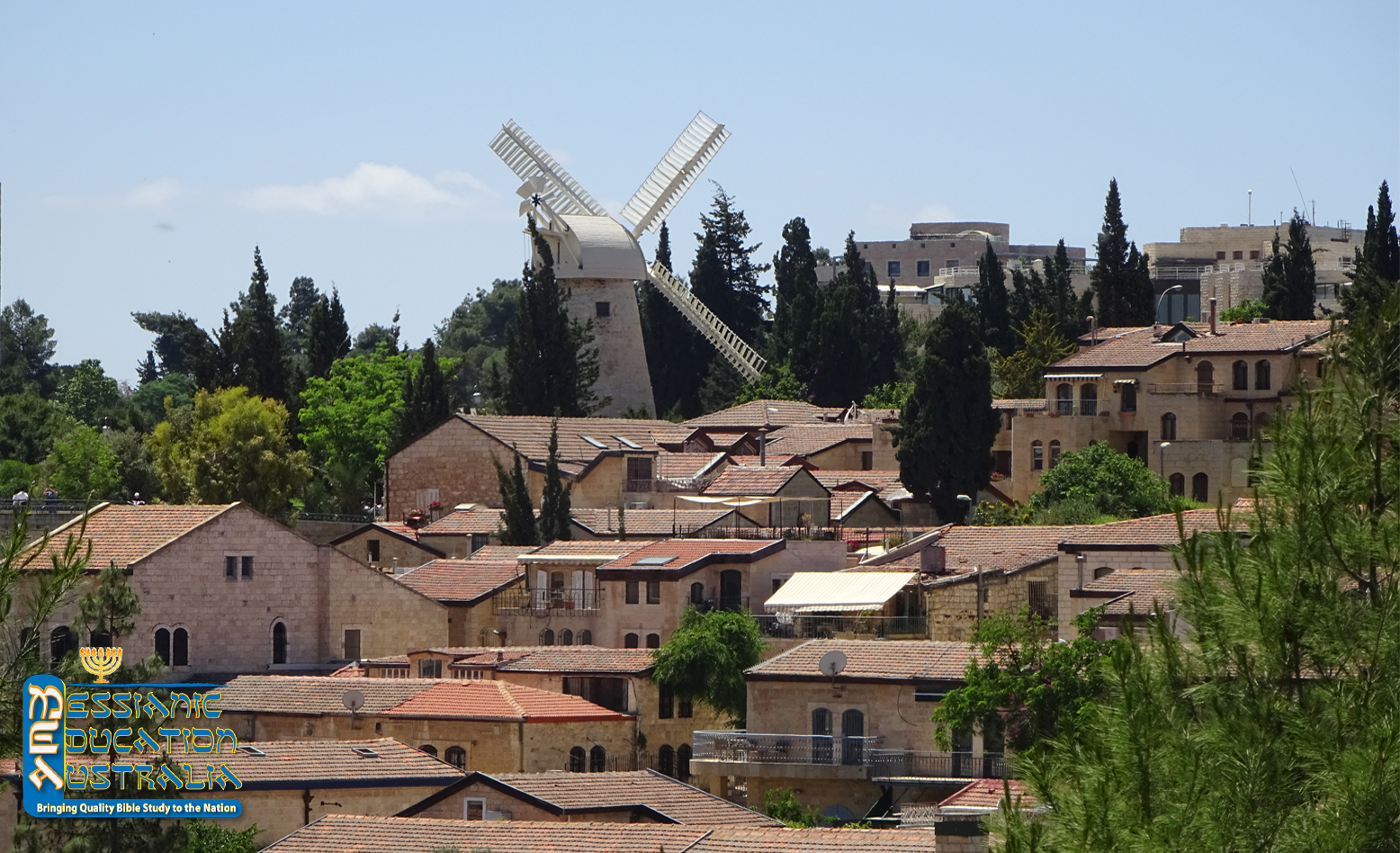
Israel-©-MEA-20180228-(C285)-Historical-Icons-of-Israel–Montefiore-Windmill
Historical Icons of Israel –Montefiore Windmill
The Montefiore Windmill, built by English Jewish philanthropist Moses Montefiore, was one of the first structures to be erected outside the borders of Old City in Jerusalem during the middle of the 19th Century. This four-bladed windmill of European design was finished in 1857. This fully-functional agricultural wheat-grinding windmill was to be a beacon for Jerusalem’s future, an inspiration to the Jews of Palestine to become more self-supporting. Unfortunately, despite the good intentions, the wind in the area was unreliably and often not strong enough to provide efficient and constant milling of the hardier crops of the area. So, after 18 years it was made obsolete, unable to compete with other methods of flour production. It would be more than a century later before it would be resurrected. Even so, the windmill did manage to inspire people to relocate to the area establishing homes, synagogues, businesses and trade.
The Montefiore Windmill sat empty for decades until the Israeli army used it during the War of Independence as a watch post. Then the British forces blew the top off of the windmill in an action known as ‘Operation Don Quixote’. Following this, the damaged building sat empty until 2012 when, as part of the celebrations of the 60th anniversary of the establishment of Israel, the windmill was completely restored.
A book published in 1933 referred to the windmill as the Jaffa Gate Mill, and mentioned how local millers were opposed to the windmill, even to point of cursing it because it was seen to be the work of Satan. Also, some Arabs developed a taste for the lubricating oil used on the bearings, but soon stopped licking the oil for fear the mill would burn down from the resulting friction. This unsavoury habit ceased not long after a leg of pork was placed in the oil barrel.
Today the Montefiore Windmill, whose blades spin five days a week, stands as a monument to the creation of modern Israel and offers visitors a fine historical museum highlighting the life of Moses Montefiore.
Copyright exists in all the material on this website and is owned by Messianic Education Australia Ltd. unless otherwise explicitly stated. This copyright extends to the images, logos, layout and presentation styles as well as the text material.