Pictures from Israel

Click to enlarge
Israel-©-MEA-20180221-(C30)-Historical-Icons-of-Israel–The-Kotel
Historical-Icons-of-Israel–The-Kotel
The Kotel or the Western Wall, is the most significant prayer site in the world for the Jewish people. It is the last remnant of their Temple which was destroyed by the Romans in 70 AD. Many Jewish people from around the world gather here to pray and sometimes leave written prayer notes pushed between the mortar and the great ancient stones of the limestone wall. According to Jewish history and tradition, this Temple mount was originally known as Mount Moriah, and the place where many pivotal events in Jewish history occurred.
Traditionally, it is where the ‘Foundation Stone’ was set up for the creation of the world. Also, it is where Adam, the first human, was brought to life, and “the place which God chose” for Abraham to sacrificed his son Isaac—the peak of Mount Moriah. Also from the Bible, it is believed that there is a link between Mount Moriah and Jacob’s amazing dream of angels ascending and descending a ladder joining heaven and earth. There is another suggestion that the Holy of Holies, the holiest place within the First and Second Temples built around this same ‘Foundation Stone’.
In the year 37 BCE, Herod was appointed king in Jerusalem and soon began renovating the Second Temple which was almost completed by the time he died in 4 BCE. It was quite magnificent. In order to accommodate the total area required, Herod widened the land and built four support walls around it. However, the Western Wall was the only one that survived the Jerusalem’s. Sometime later in history, it become the central icon of Jewish identity and prayer.
After the 1948 Arab-Israeli War, the Eastern portion of Jerusalem was occupied by Jordan who expelled all Jews from the ‘Old City’ including the Jewish quarter which effectively barred them from praying at the Western Wall. However, on June 10, 1967, at the conclusion of the famous Six-Day War, All of Israel and Jewish people around the world rejoiced when the Western Wall was once again back in their hands.
Copyright exists in all the material on this website and is owned by Messianic Education Australia Ltd. unless otherwise explicitly stated. This copyright extends to the images, logos, layout and presentation styles as well as the text material.
Pictures from Israel

Click to enlarge
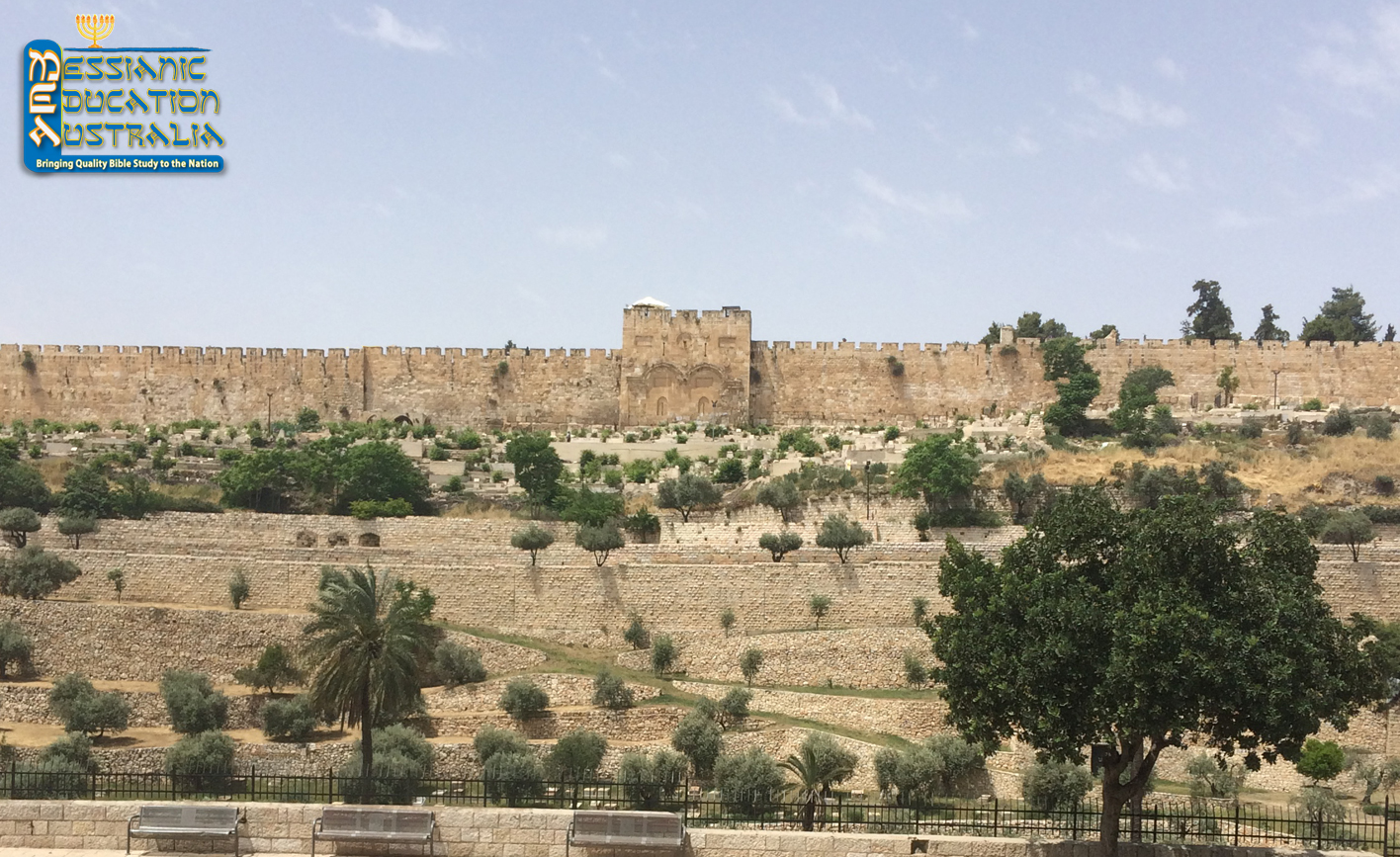
+Israel-©-MEA-20180214-(N741)-Historical-Icons-of-Israel–Graveyard-Mt Olives
Historical Icons of Israel –Graveyard on the Mount of Olives
The Jewish Cemetery on the Mount of Olives is the most ancient and most important cemetery in Jerusalem and also the largest and holiest cemetery in the Jewish world. Burial on the Mount of Olives started some 3,000 years ago in the First Temple Period, and continues to this day. The cemetery contains anywhere between 70,000 and 2-to-300,000 tombs from various periods, including the tombs of famous figures in Jewish history. During the time of the First and Second Temples, the Mount of Olives was the place where the high priest would sacrifice a ‘Red Cow’ and then take the purified ashes from the Temple across to the Mount of Olives where they would be used to purify all those who were impure.
It is the final resting place of well-known Jewish people such as: Eliezer Ben-Yehuda, a Hebrew lexicographer and newspaper editor and driving force behind the revival of the modern Hebrew language; Rabbi Abraham Isaac Kook, the first Ashkenazi Chief Rabbi in the British Palestine Mandate; Rabbi Obadiah of Bertinoro (Bartenura), a 15th-century Italian, best known for his commentary on the Mishnah, and in his later years, rejuvenated the Jewish community of Jerusalem and became recognised as the spiritual leader of the Jews of his generation; Rabbi Judah Ben Samuel (also known as Judah the Pious), a legendary and scholarly 12th century German rabbi who made some astonishing and specific predictions about the future of Jerusalem and Israel, which came true; and Rabbi Yehosef Schwartz, who published the first Jewish geographical maps of Palestine since the 14th Century.
From the 10th Century B.C.E., Jews of Jerusalem were buried in burial caves scattered on the slopes of the Mount, and from the 16th century the cemetery began to take its present shape. After the Six Day War of June 1967, interment ceremonies were held in the Jewish cemetery on the Mount of Olives for the civilians and soldiers who were residents of the Old City of Jerusalem and killed during the 1948 War of Independence.
The Jewish cemetery on Mount Scopus “Mount of the Watchmen/Sentinels“ was divided in two by the highway leading to Jericho. West of this highway is the earliest section of the cemetery, which stretches as far as the tombstones of the Kidron Valley. The newer section is located on the western and southern slopes of the Mount of Olives. The entire cemetery is divided into sections, each section belonging to a different Jewish community or sect. During the period of Jordanian rule, the Jewish cemetery on the Mount of Olives suffered extensive damage. Many of the headstones were removed and used to build the Jordanian Legion Camp which was confirmed by a group of Israeli Army chaplains and members of the Jerusalem Chevra Kadisha (Religious Burial Society) who inspected the camp site. Nearly the entire camp was built with tombstones carted from the cemetery and used for the main parade ground, roads, buildings and even the lavatory structure. Inscriptions were still visible on the desecrated stones and efforts are being made to trace the location of the graves and replace the stones.
Copyright exists in all the material on this website and is owned by Messianic Education Australia Ltd. unless otherwise explicitly stated. This copyright extends to the images, logos, layout and presentation styles as well as the text material.
Pictures from Israel

Click to enlarge
+Israel-©-MEA-20180207-(N36)-Historical-Icons-of-Israel–Great-Synagogue
Historical Icons of Israel – The Great Synagogue
In 1720 Rabbi Judah HeHasid and 1,500 followers spent three years trekking from Poland to Jerusalem, in the conviction that their move would hasten the coming of the Messiah. He immediately purchased the land on which the synagogue would be built but sadly died five days after arriving in Jerusalem. The surviving 300 of his followers began to build the synagogue, using money lent at exorbitant rates of interest by local Muslims, but it was not completed. At the time, it was the only Ashkenazi synagogue in Jerusalem. After two decades the impoverished community was unable to keep up with the mounting payments and the Muslims destroyed the synagogue, demolished the homes of the Ashkenazi community which held the debt, and expelled the Ashkenazi Jews from Jerusalem.
Over the years rulers, rabbis and other visitors came to the synagogue and historical events took place under its roof. This went on until 1948. During Israel’s War of Independence, two weeks after the State of Israel was born and following day after day of bloody battle, Jordanian soldiers of the Arab Legion blew up the entire synagogue. For the second time in its history, the Hurva Synagogue was reduced to rubble. The Jordanians were fully aware of the synagogue’s symbolic importance and its destruction was intended as a demonstration of victory and meant to show that the Jewish presence in the Old City had reached a permanent end. Jewish presence in the Jewish Quarter was interrupted for 19 years.
Following the Six-Day-War of 1967, in which Israel won back Eastern Jerusalem and the city was once again reunited, the Jews returned and rebuilt the Jewish Quarter. It was also decided to rebuild the Hurva Synagogue, while retaining and recreating one of the four arches that had supported the famous dome. This arch became a symbol of Jewish solidarity and presence in the Jewish Quarter and indeed, the Old City in general. The Hebrew word Hurva or Chuvah means ‘destroyed to ruins’, and relates to the previous Ashkenazi synagogue and place of worship.
Three decades later, at the turn of the Century, the Israeli Government rebuild the Hurva in its original style. Completed in 2010, the Hurva Synagogue was officially rededicated in March 2010 and became a centre of community activity. It has an especially beautiful interior, with the world’s tallest Holy Ark, which traditionally houses the precious Torah scrolls. Visitors to the Hurva Synagogue have the opportunity of hearing and reading about its history, and from the veranda surrounding its high dome, can enjoy a breathtaking 360-degree view of Jerusalem.
Copyright exists in all the material on this website and is owned by Messianic Education Australia Ltd. unless otherwise explicitly stated. This copyright extends to the images, logos, layout and presentation styles as well as the text material.
Pictures from Israel

Click to enlarge
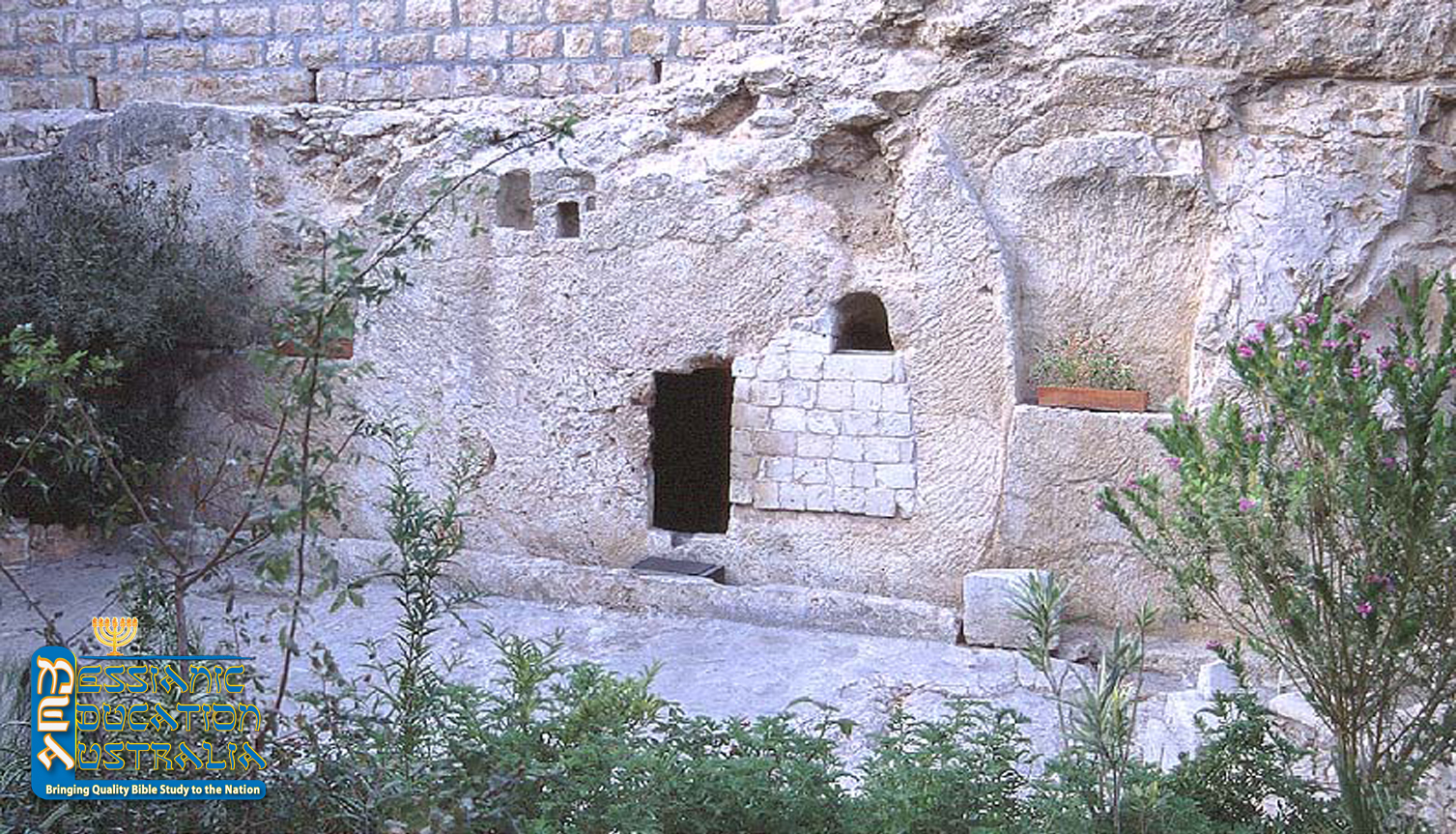
+Israel-©-MEA-20180131-(FRD01)-Historical-Icons-of-Israel–Garden-Tomb
Historical Icons of Israel – The Garden Tomb
The Garden Tomb with its neatly maintained gardens and trees, provides a tranquil environment for prayer and reflection. It is located close to the Damascus Gate of Jerusalem’s Old City. Within the garden at a placed called Golgotha (Place of the Skull) is a tomb, a winepress and a water cistern, including burial benches which were made sometime between the 4th and 6th Century of the Byzantine period.
The Garden Tomb is generally regarded by Protestants to be the tomb in which Messiah was buried. However, the Catholic Church favours the Church of the Holy Sepulchre to be the more accurate historical site. The New Testament tells us that after Jesus was crucified, a rich religious leader named Joseph (of Arimathea) was given permission by Pilate to take and bury the body. Also known as Gordon’s Calvary, the Garden Tomb is what you could call the “rival” to the Church of the Hoy Sepulcher. It is called Gordon’s Calvary because in 1883 British General Charles Gordon suggested that this outcropping of rock just across the street from the north city wall was indeed Golgotha. His discovery gained momentum because the garden tomb had been found near this location in 1867, and the words sited in Hebrews 13:12, “He suffered outside the gate,” are used to confirm this.
Interestingly, archaeologists estimate this tomb to have been established between 900 BC and 700 BC, corresponding with the Old Testament later period. This reckoning casts doubt on the claim that this is the same tomb in which Messiah was buried, because there are several references to Messiah’s burial place being a new tomb, e.g. in Matthew 27:60, it says that Joseph (of Arimathea), “…laid it in his new tomb which he had hewn out of the rock; and he rolled a large stone against the door of the tomb, and departed. Also in John 19:41 it says, “Now in the place where He was crucified there was a garden, and in the garden a new tomb in which no one had yet been laid.”
Copyright exists in all the material on this website and is owned by Messianic Education Australia Ltd. unless otherwise explicitly stated. This copyright extends to the images, logos, layout and presentation styles as well as the text material.
Pictures from Israel

Click to enlarge
+Israel © MEA-20180124 (V101) Historical Icons of Israel -King David’s Harp
Historical Icons of Israel -King David’s Harp
In this picture we see two dedicated musicians playing their harps in two different places in Jerusalem. The musician on the left is playing within the City of David, currently an archaeological site, while the other musician is playing her harp in an alcove within the walls of the ancient Old City.
The most famous harp in history is the Harp of David. There is much speculation as to the actual shape of this harp. However, what is generally accepted is that it was symmetrical with perhaps 10 strings and known as the Kinnor Harp. What we know from the sages, is that David was not only an expert harpist and psalms composer, who used harp therapy in the royal court of King Saul, but also a recognized musicologist and builder of classical harp designs.
Mention of the harp goes back to about 4004 BC, where in Genesis 2:40, the Bible credits the House of Jubal as the maker and players of harps and flutes. The oldest physical harp to be discovered comes from ancient Sumerian and Egyptian societies. The kinnor is mentioned 42 times in the Old Testament, in relation to “divine worship… prophecy… secular festivals.” Sages record that a minimum number of nine kinnor were to be played in the Temple at any one time.
The Bible says that David also made 1,000 lyres and 7,000 harps to atone for the sins of Israel. As well, cymbals and other instruments were used for singing and praising the God of Israel, of which some were even handed down from the time of Moses with the inscription, “Under his feet was something like a sapphire stone pavement in the essence of heaven’s clarity” from Exodus 24:10. Interestingly, one etymology viewpoint of the Hebrew word ‘Kinneret’, as in Lake Kinneret’ (Sea of Galilee), is that the shape of the lake resembled that of the kinnor harp, as its name implies.
Copyright exists in all the material on this website and is owned by Messianic Education Australia Ltd. unless otherwise explicitly stated. This copyright extends to the images, logos, layout and presentation styles as well as the text material.
Pictures from Israel

Click to enlarge
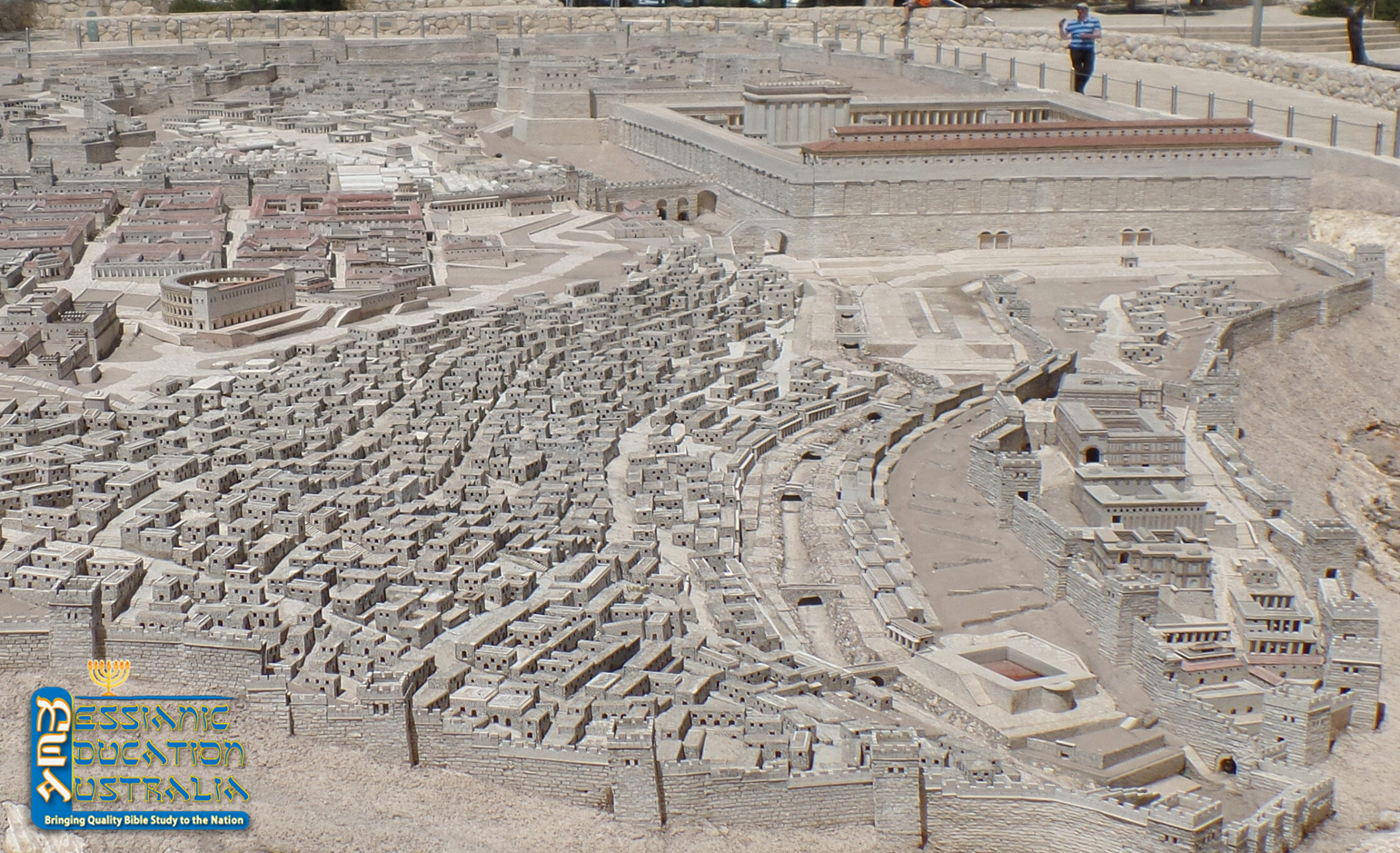
+Israel © MEA-20180124 (PF319) Historical Israel -Herod’s Temple
Historical Israel -Herod’s Temple
On the eastern edge of Jerusalem, just west of Gethsemane and northwest of the Kidron Valley, sat the Temple of Herod. Literature states that the outer walls formed a rough rectangle, 500 feet long by 100 feet wide, slightly narrower on the south than the north, and slightly tilted to the northwest. Archaeological evidence has the dimensions closer to 1,550 feet by 1000 feet. On the far northwest corner sat Antonia Fortress, the home of the temple garrison that stayed alert for disturbances in the temple—disturbances that could gain the governor unwanted attention from Rome.
This 50:1 scale model, covering nearly one acre, shows ancient Jerusalem and the Temple at its peak, meticulously recreating its topography and architectural character in 66 CE, the year in which the Great Revolt against the Romans broke out, leading to the destruction of the Temple and the city in the year 70 CE. The model, a Jerusalem cultural landmark, was originally built at the initiative of Holyland Hotel owner Hans Kroch in memory of his son Jacob, who fell in Israel’s War of Independence in 1948. The model includes a replica of the Herodian Temple. [To get an aerial view of this picture, cover over the man at the top of the picture with your thumb and look at the picture again.]
The model was opened to the public in 1966, immediately becoming a popular attraction and educational site for Israelis and tourists alike. In 2006 the model was transferred to the Israel Museum campus, where it offers a concrete illustration of the period documented in the Dead Sea Scrolls, when Rabbinic Judaism took shape and Christianity was born. Providing a vivid context for the Shrine of the Book and the Dead Sea Scrolls and for many contemporaneous archaeological artefacts displayed throughout the Museum, the Model Illustrates one of the most formative periods in the history of the Jewish people, and bears a deep connection to the symbols of modern statehood that surround the Museum campus. In preparation for the move, the model was sawn into 1,000 pieces and later reassembled. The Holyland Hotel spent $3.5 million on the move.
Copyright exists in all the material on this website and is owned by Messianic Education Australia Ltd. unless otherwise explicitly stated. This copyright extends to the images, logos, layout and presentation styles as well as the text material.