Pictures from Israel

Click to enlarge
+Israel © MEA 20180110 (JS244)-Historical Sites in Israel -Golden Gate
Historical Sites in Israel: The Golden Gate
The Old City of Jerusalem is surrounded by a wall containing eight major gates. The Eastern Gate, facing the Mount of Olives across the Kidron Valley, is unique in that it was sealed shut by the Ottoman Empire under Suleiman the Magnificent in 1540-41 A.D. who believed that sealing up the Golden Gate would prevent the coming Jewish Messiah from gaining entrance to Jerusalem to rule and reign.
The Eastern Gate of Jerusalem is also called the Golden Gate or the Beautiful Gate (Acts 3:2). In Hebrew, it is Sha’ar Harahamim, the “Gate of Mercy.” It is currently the oldest gate in the Old City, (6th or 7th century A.D.) built on top of the original ancient Golden Gate which may date back to the time of Nehemiah.
When Yeshua used this gate when entering Jerusalem from the Mount of Olives. It’s the sealing of Jerusalem’s Eastern Gate that has caused many students of prophecy to sit up and take notice. The book of Ezekiel contains several references to a gate that faces east. In Ezekiel 10:18-19, the prophet sees the glory of the Lord leave the Temple through:
“They paused at the entrance to the east gate of Adonai’s house”; “Next, the glory of Adonai rose from within the city and stood over the mountain which is on the east side of the city” (Ezekiel 11:23). Later, Ezekiel sees the glory of the Lord return to the temple via “the gate facing east” (Ezekiel 43:1-5). Some interpret these passages in Ezekiel as references to the Messiah. The glory of the Lord coming into the temple is the triumphal entry (Ezekiel 43:2; Matthew 21:1–11).
Copyright exists in all the material on this website and is owned by Messianic Education Australia Ltd. unless otherwise explicitly stated. This copyright extends to the images, logos, layout and presentation styles as well as the text material.
Pictures from Israel

Click to enlarge
Israel © MEA 20180103 (N220) Historical Sites in Israel -Mount of Olives
Historical Sites in Israel -Mount of Olives
The Mount of Olives above is one of three hills on a long ridge to the east of Jerusalem. Rising to more than 800 metres, it offers an unrivalled vista of the Old City and the Temple Mount. The Mount of Olives is historically famous as it was once covered with olive trees, notwithstanding that there are some still alive and well today that are purported to be 2000 years old. Many an olive tree on this hill have born witness to well-known events recorded in the Bible.
King David fled over the Mount of Olives to escape when his son Absalom rebelled. After King Solomon turned away from God, he built pagan temples there for the gods of his foreign wives (2 Samuel 15:30 and 1 Kings 11:7-8). Ezekiel had a vision of “the glory of the Lord” ascending from the city and stopping on the Mount of Olives (Ezekiel 11:23). Zechariah prophesied that in the final victory of the forces of good over evil, that the Lord of Hosts would “stand on the Mount of Olives” and the mount would be “split in two from East to West”, (Zech 14:3-4).
Yeshua went often to the Mount of Olives, a 40-minute walk from the Temple to Bethany; there He rested and prayed. He went down from this Mount on His triumphal entry to Jerusalem on what is affectionately known as Palm Sunday. Here he wept over the city’s imminent destruction, (Luke 19:29-44). In a major address to His disciples on the mount, he foretold his second coming. (Matthew 24:27-31). He prayed there on that fateful night before he was arrested and subsequently killed, (Matthew 26:30-56). And, He ascended into heaven from the Mount of Olives (Acts 1:1-12).
Until the destruction of the Temple, the Mount of Olives was a place where many Jews, during times of pilgrimage, would sleep out under the olive trees. Also, during the Siege of Jerusalem which led to the destruction of the City in AD 70, Roman soldiers from the 10th Legion camped on the mount.
In Jewish tradition, the Messiah will descend the Mount of Olives on Judgement Day and enter Jerusalem through the Golden Gate (the blocked-up double gate in the centre of the eastern wall of the Temple Mount), also known as the Gate of Mercy, or the Beautiful Gate. For this reason, Jews have always sought to be buried on the slopes of the mount. The area serves as one of Jerusalem’s main cemeteries, with an estimated 150,000 graves.
Among them are complex catacombs called the Tombs of the Prophets. It is said these catacombs contain the graves of the prophets Haggai, Zechariah and Malachi who lived in the 6th and 5th centuries BC. From Byzantine times the mount became a place of church-building, and by the 6th century it had 24 churches surrounded by monasteries inhabited by large numbers of monks and nuns.
Copyright exists in all the material on this website and is owned by Messianic Education Australia Ltd. unless otherwise explicitly stated. This copyright extends to the images, logos, layout and presentation styles as well as the text material.
Pictures from Israel

Click to enlarge
+Israel © MEA 20171227 (N243) Historical Sites in Israel -Temple Institute
Historical Sites in Israel -Temple Institute
The Temple Institute (Machon HaMikdash), founded in 1987, is a non-profit educational and religious organization located in Jerusalem’s Jewish quarter within the walls of Old City. It is making preparations for the building and furnishing of the ‘Third Temple’, complete with priests and sacrifices. Historically, the Jewish people, on returning to the ‘Promised Land’ in their own right, have always rebuilt Jerusalem first, followed by the rebuilding of the Temple.
Such was the case when Solomon’s Temple was destroyed by the Babylonians under Nebuchadnezzar in 586 B.C.E. and they began to rebuild it after their 70-year exile. Also, when the Jewish resistance won back their land and rededicated the Temple after the Greek ruler Antiochus IV devastated Jerusalem and defiled the Temple in 167 B.C. The last Temple, built by Herod was destroyed in 70 A.D. by the Romans. Interestingly, Jerusalem has been captured at least 40 times and besieged about 23 times by invading forces who wanted to control the city, not destroy it. And, even today the struggle for control of Jerusalem continues.
The Temple Institute’s short-term goal is to rekindle the flame in the hearts of people by raising public awareness of the Holy Temple, which was central and sacred to their religious life. The Institute has begun to restore and construct the sacred vessels for service in the Holy Temple, made according to the exact specifications of the Bible, and constructed from original source materials, e.g. gold, copper, silver and wood. These are authentic, accurate vessels, not merely replicas or models, including the three most important items: the seven-branched Menorah or candelabra, made from pure gold, the golden Incense Altar, and the golden Table of the Showbread.
Visitors can see these restored sacred vessels and original paintings at The Temple Institute’s Visitors’ Centre in the Jewish Quarter of the Old City of Jerusalem.
“Go up to the mountains and bring wood and build the temple, that I may take pleasure in it and be glorified,” says the Lord. (Haggai 1:8)
Copyright exists in all the material on this website and is owned by Messianic Education Australia Ltd. unless otherwise explicitly stated. This copyright extends to the images, logos, layout and presentation styles as well as the text material.
Pictures from Israel

Click to enlarge
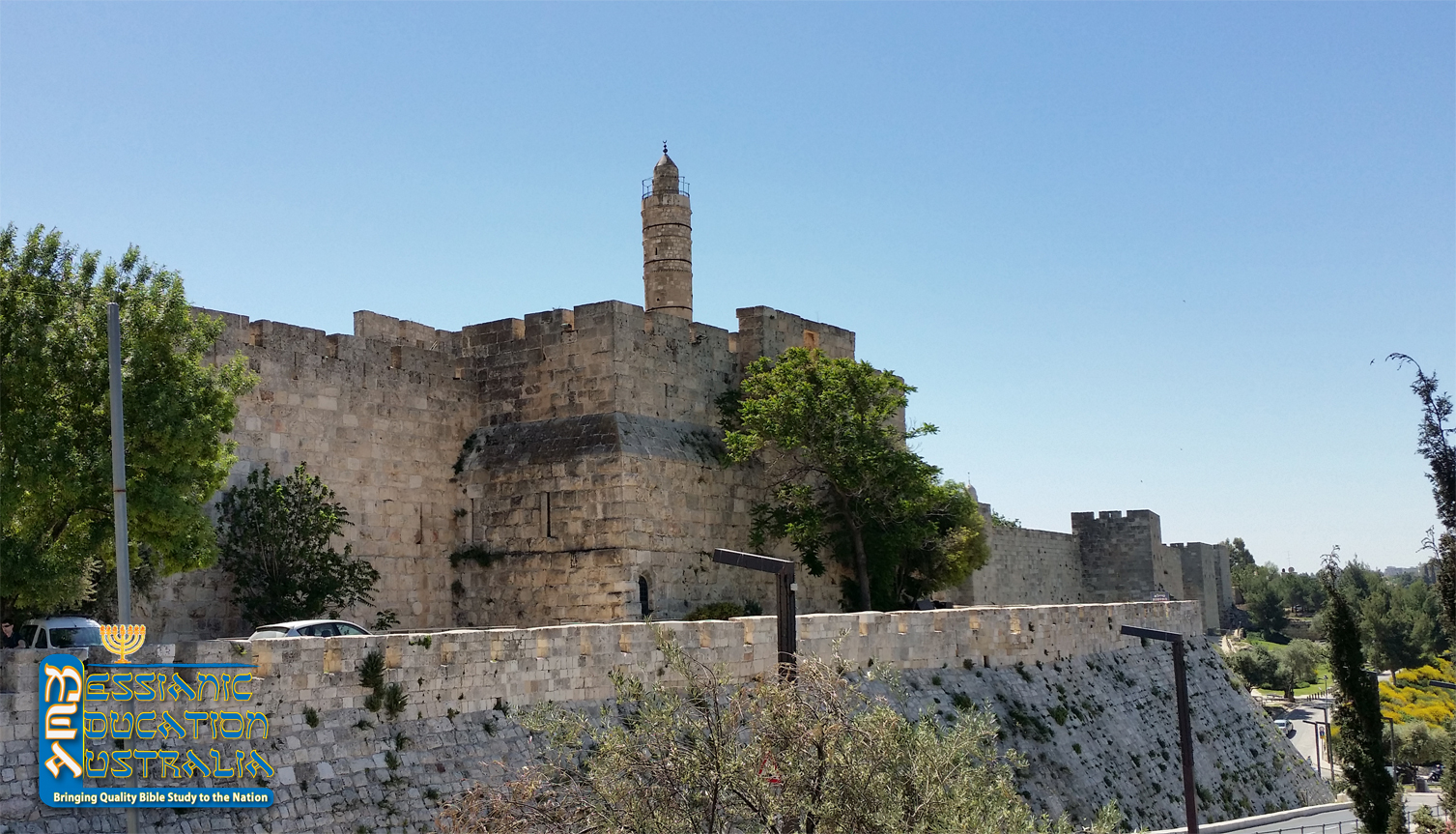
Israel-©-MEA-20171220-(N146)-Historical-Sites-in-Israel–Tower-of-David
Historical Sites in Israel –Tower of David
The Tower of David, also known as the Jerusalem Citadel is home to the Museum of the History of Jerusalem. The tower is an ancient citadel located near the Jaffa Gate entrance at the western edge of the Old City of Jerusalem. This citadel dates back to the Mamluk and Ottoman periods. It was built on the site of an earlier ancient fortification of the Hasmonean, Herodian-era, Byzantine and Early Muslim periods, after being destroyed repeatedly during the last decades of Crusader presence in the Holy Land by Ayyubid and Mamluk rulers. King Hezekiah was the first to specifically fortify this area.
It contains important archaeological finds dating back over 2,000 years including a quarry, dated to the First Temple period, and is a popular venue for benefit events, craft shows, concerts, and especially its highly attended ‘Light and Sound Show Spectacular’. The walls of the Citadel, about 150 metres wide, are used as the backdrop screen—very impressive. Amidst the archaeological remains in the Citadel’s courtyard and to the sound of original music, the story of Jerusalem unfolds through giant breathtaking, virtual reality images, which is the first of its kind in the world.
The name Tower of David is due to Byzantine Christians who believed the site to be the palace of King David. They borrowed the name “Tower of David” from the Song of Songs, attributed to Solomon, King David’s son, who wrote: “Thy neck is like the Tower of David built with turrets, whereon there hang a thousand shields, all the armour of the mighty men.” (Song of Songs, 4:4).
When the empire adopted Christianity as its favoured religion in the 4th century, a community of monks established itself in the citadel. It was during the Byzantine period that the remaining Herodian tower, and by extension the Citadel , acquired its alternative name – the Tower of David – after the Byzantines, mistakenly identifying the hill as Mount Zion, presumed it to be David’s palace, cited in 2 Samuel 5:11, 11:1-27, 16:22.
“David was thirty years old when he began to reign, and he reigned for forty years”. In Hebron he reigned over Judah seven years and six months: and in Jerusalem he reigned thirty and three years over all Israel and Judah.” … “So, David dwelt in the fort, and called it the city of David. And David built round about from Milo and inward”. (2 Sam 5:4-5,9)
Copyright exists in all the material on this website and is owned by Messianic Education Australia Ltd. unless otherwise explicitly stated. This copyright extends to the images, logos, layout and presentation styles as well as the text material.
Pictures from Israel

Click to enlarge
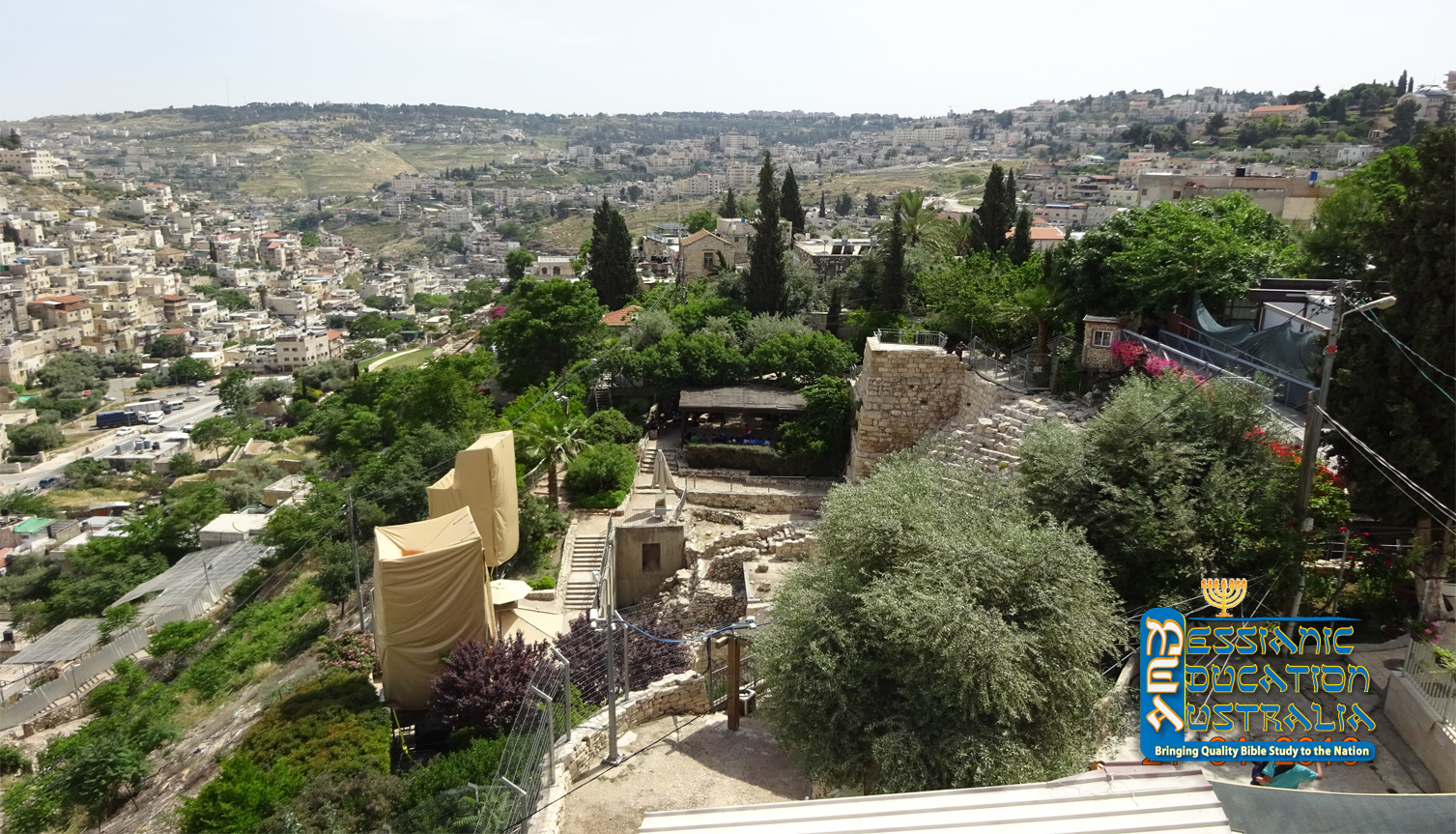
+Israel © MEA 20171213 (C79) Historical Sites in Israel -City of David
Historical Sites in Israel – City of David, Jerusalem
About three thousand years ago, King David left Hebron for Jerusalem, in his vision, a large central and important goal – the unification of Israel around one capital city. David`s son, Solomon, established the first Temple on Mount Moriah, which rises slightly north of the City of David. Here in fact, was created the first deep connection to Jerusalem by King David, which is embedded deeply into the history of Israel.
Jerusalem is situated on an eastern hill, towering to a height of 743 meters above sea level. The hill lies on the southern slopes of Mount Moriah, surrounded by mountains (as written in Psalms – Jerusalem surrounded by mountains), Temple Mount to the North, Mount of Olives to the East, Mount Zion to the West and to the South – Armon Hanatsiv (High Commissioner’s Palace) ridge. It had fresh water from the Gihon Spring gushing at its foot. Besides David and his son Solomon, this would have been the stamping ground of kings Hezekiah and Josiah and the prophets Isaiah and Jeremiah.
With the death of King Solomon, the kingdom was split into the Kingdom of Judah and Israel, and Jerusalem remained only the capital of the Kingdom of Judah. After the Assyrian conquest of the Kingdom of Israel and the exile of the ten tribes, a large flow of refugees came to Jerusalem.
The city expanded and encompassed the entire western hill, apparently including the areas today known as the Jewish Quarter, the Armenian Quarter and Mount Zion outside the walls of the Old City of today. During the reign of Hezekiah, the city was surrounded by a wall, and the Gihon Spring was directed into and under the city.
The City of David is actually the ancient core of Jerusalem, from which the city grew and developed throughout history. A collection of archaeological finds is a testimony and to a lifetime of activities that took place here before, during the first Temple era around 1000 BCE.
Today the City of David is a small magical hill located near the Western Wall. It covers an area of about 60 acres, from where one can enjoy a variety of tours and activities that take visitors to a fascinating historical journey, to the days of the First Temple, a period of ancient Jerusalem.
Copyright exists in all the material on this website and is owned by Messianic Education Australia Ltd. unless otherwise explicitly stated. This copyright extends to the images, logos, layout and presentation styles as well as the text material.
Pictures from Israel

Click to enlarge
Israel-©-MEA-20171206-(577)-Historical-Landmarks-Hessed Ve-Rahamim Sephardi Synagogue in Jerusalem
Mazkeret Moshe (Hebrew: מזכרת משה) is a former courtyard in Jerusalem. Today it is part of the Nachlaot neighborhood. Mazkeret Moshe was founded in 1882 from the ardent financial support of British Jewish financier and banker, Moses Montefiore. The name “Mazkeret Moshe” means “memorial to Moses.” This neighbourhood was intended for Ashkenazi Jews, while the adjacent neighbourhood Ohel Moshe, also funded by Montefiore’s foundation, was intended for Sephardi Jews.
Hessed Verahamim Synagogue is a Sephardi synagogue in Mazkeret Moshe that was once a PUB. In the late 1920’s, the neighborhood butcher convinced the pub owner to turn the building into a synagogue. The doors are covered with silver plates illustrating the Twelve Tribes.
Jerusalem is estimated to possess some 200 churches, 40 mosques, and well over 1,000 synagogues. Most Jewish places of worship in the city are small, easy to miss, and reflect the character of their immediate neighbourhoods. Most of the synagogues are also Sephardi.
Whereas centrally-located Ashkenazi synagogues tend to be large in size and doughty in presence, their Sephardi counterparts tend to be more restrained in decor, with a warm, relaxed intimacy, and a deep-seated pride in their cultural identity and traditions. They are also more ubiquitous: choose at random a Jerusalem synagogue and it is most likely to be Sephardi.
Their numbers rose exponentially during the Selichot period in the 40-day penitential period preceding Yom Kippur, and the rising inflows of visitors and tourists pack out their sanctuaries in the pre-dawn hours. These pilgrims happily trade a good night’s sleep for the unforgettable Sephardi prayer-fervor and traditional melodies. There is also the sense of being a latter-day hanger-on to the tradition of the beadles of yesteryears’ pre-dawn watch knocking on the doors to round up the locals to prayer
But if you’ve only one to choose from, consider the richly-decorated Hessed Ve-Rahamim (“kindness and mercy”) Synagogue on HaCarmel Street, in central Jerusalem.
Like most places of worship in the neighborhood, it follows the authentic Sephardi Jerusalem liturgy and full-throated singing. Its Iraqi-accented origin is best tasted on Simchat Torah – with the kubbeh metugan (fried cracked-wheat dish) stuffed with mincemeat, hard-boiled eggs, and pickled cucumbers, served after the morning service.
In the gathering dusk and from a little distance, its iron-hammered logos of the Twelve Tribes and the Eshet Chayil (Woman of Valour) prayer evoke the facade of the house of the Gingerbread Man – an impression that is not entirely misleading, as some 90 years ago the building was a pub.
According to local lore, Jewish butcher Isaac Emosa changed all that by buttonholing the owner with £10 sterling in exchange for an instant quit.
Like all Orthodox synagogues, Hessed Ve-Rachamim is gender-segregated, with the women upstairs in the gallery. They do, however, fully participate from above in the time-honored Sephardi tradition in calling out bids during the auctioning of aliyot and other mitzvot – though they pass these on to the men of their choosing.
Copyright exists in all the material on this website and is owned by Messianic Education Australia Ltd. unless otherwise explicitly stated. This copyright extends to the images, logos, layout and presentation styles as well as the text material.